
Blog
Nail Education That Builds Salon Confidence
Nov
A flawless set is not created by product alone. It comes from the technician behind the brush: how they prepare the natural nail, control their application, understand their system and make the right decision when a service does not go to plan. Nail education gives those decisions a professional foundation. For anyone building a career, refining a salon menu or moving beyond at-home practice, it is what turns a good-looking result into a service clients trust enough to rebook.
The nail industry moves quickly. One season brings chrome finishes and velvet effects; the next puts a fresh spin on French tips, sculpted structure or expressive nail art. Trends matter, but lasting success comes from having the technique to deliver them safely, consistently and at a pace that works commercially. Fashion For Fingers should still perform beautifully after the client leaves the salon.
Nail education is a commercial skill
Training is often viewed as the starting point of a nail career. It is that, but it should not stop there. A foundation course can teach the essential order of a treatment, while ongoing learning gives a technician the confidence to improve retention, add services and work with more advanced products.
That confidence affects every part of the appointment. A technician who understands product chemistry is less likely to overwork gel, contaminate a brush or mix systems without checking compatibility. Someone trained in correct preparation can identify when dehydration, cuticle work or product application needs adjusting. Those details may not be dramatic on social media, but they are often the difference between a client returning in three weeks with a perfect set and returning with lifting.
For salon owners, education is also a business decision. Consistent techniques make it easier to protect service standards across the team, price treatments with confidence and reduce costly product waste. For students, it helps build employable habits before speed becomes the main focus. Speed has value, but it must be earned through controlled repetition, not rushed application.
What quality nail education should teach
A strong course should do more than demonstrate a finished look. It should explain why each stage matters, allow time to practise and give learners a clear standard to work towards. The best training makes technical language useful on the salon floor rather than intimidating.
Preparation, hygiene and consultation
Every dependable service begins before colour is selected. Learners need to understand natural nail anatomy, consultation questions, contraindications and when it is appropriate to postpone or decline a treatment. This protects the client, the technician and the reputation of the salon.
Hygiene must be taught as a working routine, not as a quick mention at the beginning of a course. That means cleaning and disinfecting tools correctly, handling files and buffers appropriately, maintaining a tidy workstation and preventing cross-contamination during every appointment. Electrical tools, dust control and safe product storage also deserve proper attention, particularly as a technician moves into enhancement services.
Preparation is equally precise. The aim is not to aggressively file the nail plate or remove healthy tissue. It is to create a clean, suitable surface while respecting the natural nail. Over-preparation can lead to thinning, sensitivity and poor client confidence. Under-preparation can compromise adhesion. Training should make that balance clear.
Product control and system knowledge
Gel polish, builder gel, acrylic and hard gel all have different working characteristics. They may look similar once finished, but they require different application methods, curing requirements and removal processes. A technician should know what their chosen system is designed to do, rather than relying on guesswork or a viral video.
This is especially relevant when building a treatment menu. BIAB-style builder services may suit clients seeking structured overlays, while acrylic may be the better choice for sculpted extensions and dramatic length. Gel polish can be ideal for clients who want colour and shine on natural nails. There is no single product category that is best for every client. Nail education teaches technicians to match the service to the nail, lifestyle and desired result.
Curing is another area where shortcuts cause problems. Lamp compatibility, recommended cure times, product thickness and complete coverage all matter. Under-cured product is not simply an inconvenience. It can affect durability and increase unnecessary client risk. Professional training should reinforce manufacturer instructions and encourage technicians to work responsibly with the products they choose.
Structure, shaping and finishing
A beautiful colour cannot disguise poor structure. Enhancement training should cover apex placement, sidewall balance, stress-area support and free-edge thickness, with the shape adapted to the client’s natural nail and lifestyle. A long tapered stiletto requires different planning from a practical short square, even when both are finished in the same shade.
Finishing skills deserve the same respect. Crisp cuticle lines, balanced shaping, smooth surfaces and clean underside work make a service feel premium. They also photograph better, which matters when a technician’s portfolio is helping to sell their next appointment. Nail art should sit on top of sound application, not be used to hide uneven work.
Learning needs practice, not just watching
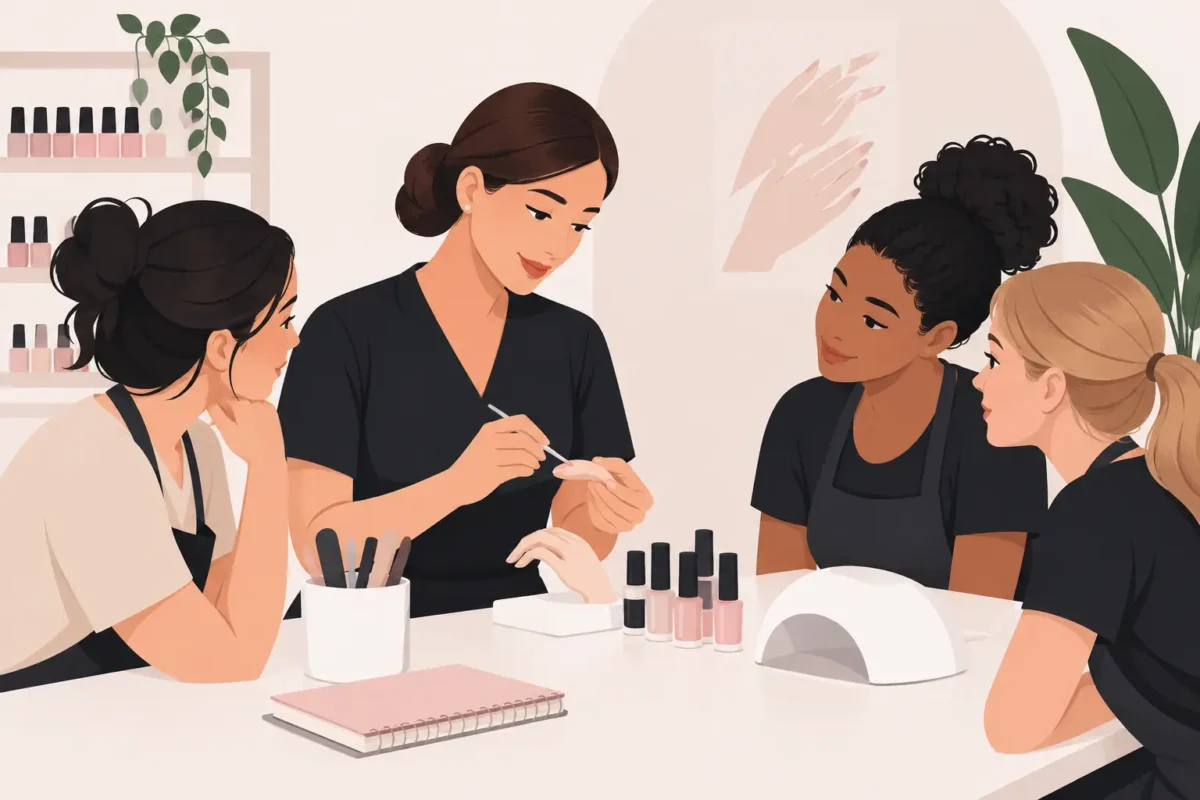
Watching a skilled educator is inspiring. Repeating the technique accurately is where progress happens. New technicians often expect confidence to arrive before practice, but it usually works the other way round. Confidence grows when you have completed the same controlled steps on different nail types and learnt how to correct small issues without panic.
A useful training programme gives learners time to work on models, receive direct feedback and revisit areas that need attention. It should also encourage portfolio building. Clear photographs of clean cuticle work, balanced structure and well-executed designs are more valuable than a gallery filled only with heavily filtered images.
Practice should be deliberate. Instead of attempting every trend in one week, choose one skill to improve: perhaps almond shaping, French placement, thin-line art or product application near the cuticle. Repeat it, photograph it and assess it honestly. A structured approach improves technique far faster than buying more products without knowing how to get the best from them.
Choosing the right course for your stage
The right route depends on where you are now and where you want your services to go. A beginner should prioritise a thorough foundation that covers consultation, sanitation, preparation, application and removal. It can be tempting to begin with advanced nail art because it is visually exciting, but artistry has more impact when the base underneath is technically sound.
Established technicians may benefit more from focused education. An acrylic technician might add builder gel services to meet demand for natural-nail overlays. A gel technician may choose an e-file course to improve refinement and appointment efficiency, provided they already understand safe manual preparation. A salon owner may want team training that aligns application methods and hygiene procedures across the business.
Before booking, look at how the course is taught. Consider whether practical assessment is included, whether the educator explains the reasoning behind the steps and whether support is available after training. Also check what kit is required and whether it uses a complete, compatible system. The cheapest option is not always the most cost-effective if it leaves large gaps in knowledge or requires you to relearn basic technique later.
Keep your education current
Professional development is not a sign that your original training was inadequate. It is how serious technicians stay sharp. New formulations, updated best practice, changing client expectations and fresh design techniques all create reasons to keep learning.
Build education into your business calendar rather than treating it as an occasional extra. Set aside time for a new course, a product demonstration, model practice or a team skills session. Track the result afterwards: did appointments become more efficient, did retention improve, can you introduce a new service, or did clients respond to a more polished finish? That is how training becomes commercially useful rather than simply another certificate.
Nail Gaga brings products and practical learning together because technicians need both: professional formulas to create with and the knowledge to use them with purpose. The strongest nail careers are built one controlled application, one honest critique and one confident rebooking at a time.
